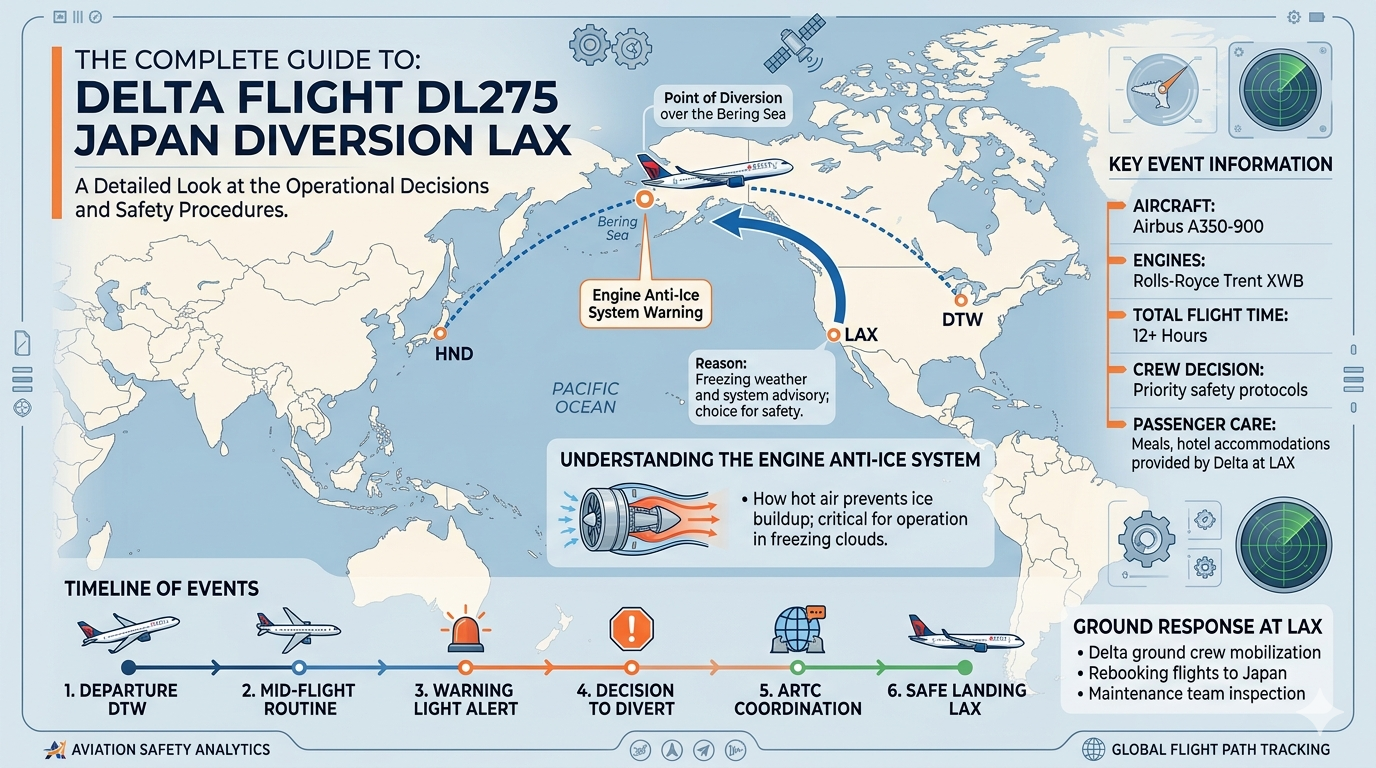
delta flight dl275 japan diversion lax
A Story of Safety, Quick Thinking, and Passenger Care
Imagine you are settled into your seat, ready for a long-haul journey across the Pacific. The cabin is calm, the lights are dimmed, and you are looking forward to landing in Tokyo. Then, unexpectedly, the pilot’s voice comes over the speaker: the plane is changing course. This is exactly what happened on Delta flight DL275, a routine trip from Seattle to Tokyo that turned into an unscheduled stop in Los Angeles. The delta flight dl275 japan diversion lax event captured attention because it showed how seriously airlines take safety. Every decision made that day was guided by one thing: protecting everyone on board. In this article, we will walk you through the timeline, the reasons behind the diversion, and how the crew handled the situation with professionalism.
You will also learn what it means for passengers and why such diversions, though inconvenient, are a sign of a trustworthy airline. Whether you are a frequent flyer or just curious about aviation, this story highlights the importance of putting people first.
What Is Delta Flight DL275 and Its Regular Route?
Delta flight DL275 is a well-known international route that connects Seattle-Tacoma International Airport (SEA) to Tokyo’s Haneda Airport (HND). Operated by Delta Air Lines, this flight typically carries hundreds of passengers across the Pacific Ocean. The aircraft used is often a wide-body jet like the Airbus A330-900neo or Boeing 767, designed for long-haul comfort. On a normal day, the flight takes off from Seattle in the late morning or early afternoon and arrives in Tokyo the following afternoon, crossing multiple time zones.
It is a popular choice for business travelers, tourists, and families because of Delta’s reputation for reliability and onboard service. However, aviation is dynamic, and sometimes unexpected events require quick changes to the flight plan. When the delta flight dl275 japan diversion lax happened, it reminded everyone that even the most routine flights can face surprises, and the crew’s training is what makes the difference between a minor disruption and a major crisis.
The Day of the Diversion: A Timeline of Events
On May 26, 2024, Delta flight DL275 departed from Seattle as scheduled, heading for Tokyo. Roughly a few hours into the flight, while the aircraft was over the Pacific Ocean, an incident occurred that required immediate attention. The crew encountered an unruly passenger whose behavior became a safety concern. According to reports, the individual became disruptive, prompting the flight attendants to follow standard protocols. The captain, in coordination with Delta’s operations center and air traffic control, made the decision to divert the aircraft to the nearest suitable airport.
Los Angeles International Airport (LAX) was chosen because it is a major hub with excellent facilities, long runways, and support services for Delta. The plane landed safely at LAX, where law enforcement met the aircraft. All passengers were deplaned, and the disruptive individual was taken into custody. The timeline from departure to diversion lasted several hours, but the crew handled every step with calm professionalism.
Why Did the Flight Divert to LAX? The Real Reason
Safety is the number one priority in aviation. When a passenger behaves in a way that threatens the safety or security of the flight, the captain has the authority to divert to the nearest suitable airport. In the case of delta flight dl275 japan diversion lax, the cause was an unruly passenger. While the exact details of the behavior were not fully disclosed to protect privacy, sources confirmed that the individual posed a risk that could not be managed while continuing the journey. Airlines have strict policies against any form of disruptive conduct, and the crew is trained to de-escalate situations.
However, when de-escalation is not enough, the safest option is to land as soon as possible. LAX was the logical choice because it is a large international airport with Delta facilities, customs support, and law enforcement presence. The decision ensured that the disruptive passenger was handled appropriately and that the rest of the passengers could continue their travel safely after a brief delay.
How the Crew Handled the Situation with Excellence
The flight attendants and pilots on board Delta flight DL275 demonstrated the high level of training that Delta Air Lines is known for. From the moment the disruptive behavior began, the crew followed established safety procedures. Here’s how they managed the situation step by step:
- Immediate de‑escalation: Flight attendants approached the passenger calmly, using verbal techniques to try to defuse the tension.
- Communication with the cockpit: The cabin crew promptly notified the pilots, giving them a clear picture of the severity of the situation.
- Coordinated decision‑making: The captain consulted Delta’s dispatch center and air traffic control to identify the safest diversion airport.
- Passenger updates: The crew made clear, calm announcements so that everyone on board understood why the flight path was changing.
- Orderly deplaning: After landing at LAX, the cabin crew ensured passengers remained calm and exited the aircraft in an organized manner.
Throughout the process, the crew kept passengers informed with clear, calm announcements. This transparency helped reduce anxiety among the travelers. After landing, the cabin crew assisted with an orderly deplaning and ensured that all passengers were comfortable while waiting for further arrangements. Such professionalism is a reminder that behind every flight, there is a team of dedicated individuals ready to handle the unexpected with skill and care.
What Happened After Landing at Los Angeles International Airport?
Once the aircraft touched down safely at LAX, authorities were waiting to handle the situation. The response was swift and well‑organized:
- Law enforcement officers boarded the plane and took the disruptive passenger into custody without further incident.
- The remaining passengers were deplaned and escorted to a dedicated area in the terminal where Delta staff were already stationed.
- Delta’s ground team distributed meal vouchers and arranged hotel accommodations for those who needed an overnight stay.
- Rebooking specialists worked individually with passengers to find alternative flights to Tokyo, with most travelers departing within 24 hours.
- The airline also provided text and email updates so passengers could track their new flight details in real time.
Delta’s response was swift, organized, and focused on minimizing inconvenience. While a diversion is never ideal, the way an airline handles the aftermath can make all the difference in passenger experience.
Passenger Experience: Comfort, Communication, and Care
For the passengers on board, the diversion was an unexpected interruption, but many later shared positive remarks about how the crew and ground staff treated them. Communication was key. Throughout the ordeal, flight attendants walked through the cabin answering questions and offering water or snacks. After landing, Delta’s customer service team worked directly with individuals to rebook flights or provide hotel accommodations. Several passengers noted that they appreciated the honesty of the crew about what was happening.
Instead of leaving people guessing, the pilot made announcements that explained the diversion in a calm and reassuring manner. Even though the delay caused missed connections and schedule changes, the human touch made the experience far less stressful. This level of care is exactly what travelers hope for when things go wrong. It shows that an airline values its passengers not just as customers, but as people.
A Detailed Table of the Delta Flight DL275 Diversion
A comprehensive breakdown of the incident, timeline, and response.
| Category | Details |
|---|---|
| Flight Number | Delta Air Lines DL275 |
| Original Route | Seattle (SEA) → Tokyo Haneda (HND) |
| Date of Incident | May 26, 2024 |
| Aircraft Type | Airbus A330-900neo (typical for this route) |
| Departure Time | Approximately 12:30 PM PDT |
| Diversion Airport | Los Angeles International Airport (LAX) |
| Reason for Diversion | Unruly passenger posing a safety concern |
| Time of Diversion Decision | Roughly 3–4 hours into the flight |
| Arrival at LAX | Around 3:00 PM PDT |
| Passenger Handling | Deplaned; disruptive passenger taken into custody |
| Rebooking & Accommodations | Hotel rooms, meal vouchers, alternative flights provided |
| Delta’s Response | Full refunds offered; customer service assisted passengers |
| Safety Outcome | No injuries; aircraft and passengers safe throughout |
How Delta Air Lines Prioritizes Safety and Security
Delta Air Lines has long been recognized as a leader in aviation safety. The company invests heavily in training for both flight crews and ground staff. Every year, pilots undergo rigorous simulator sessions where they practice emergency scenarios, including diversions. Flight attendants are trained in conflict resolution, medical response, and security protocols. The delta flight dl275 japan diversion lax event is a real-world example of how that training pays off. When faced with an unpredictable situation, the crew did not hesitate. They followed the procedures that had been drilled into them through countless training hours. Moreover, Delta’s operational center in Atlanta is staffed 24/7 with experts who can assist pilots in real time. This infrastructure ensures that even when a flight is over the ocean, there is always a support system on the ground ready to help. For passengers, knowing that such systems exist brings peace of mind.
Unruly Passenger Incidents: A Growing Challenge in Aviation
Unfortunately, unruly passenger incidents have become more common in recent years. According to aviation authorities, there has been a noticeable rise in disruptive behavior on flights. These incidents range from verbal abuse to physical altercations, and they can pose serious safety risks. Airlines and regulators have responded by implementing stricter policies, including zero-tolerance approaches. In the United States, the FAA can levy hefty fines against disruptive passengers.
The delta flight dl275 japan diversion lax case was a textbook example of how to handle such an event responsibly. Rather than ignoring the behavior or hoping it would subside, the crew acted decisively. This sends a clear message: safety is non-negotiable. For frequent travelers, it is reassuring to know that airlines are equipped to handle these situations professionally. It also highlights the importance of passengers treating crew members and fellow travelers with respect.
What Travelers Can Learn from This Diversion
If you ever find yourself on a flight that diverts, it helps to know what to expect. Use these practical takeaways to stay prepared:
- Trust the crew. They are trained to make difficult decisions that prioritize everyone’s well‑being.
- Stay calm and listen. Announcements will be made as soon as information is confirmed.
- Be patient with ground staff. They are working hard to rebook passengers and arrange accommodations.
- Keep essentials in your carry‑on. Medications, a phone charger, and a change of clothes can make an unexpected overnight stay much easier.
- Remember that diversions are a safety measure. They prove the airline is putting your well‑being above schedule.
The delta flight dl275 japan diversion lax event showed that even with an unexpected stop, the airline can turn a stressful situation into a manageable one. Travelers can also take proactive steps: keep essential items like medications, a phone charger, and a change of clothes in your carry-on bag. That way, if you are unexpectedly overnight somewhere, you are prepared. Most importantly, remember that diversions, while inconvenient, are a sign that your airline is putting safety above schedule.
The Role of Los Angeles International Airport (LAX) as a Diversion Hub
LAX is one of the busiest airports in the world, and it is frequently used as a diversion point for transpacific flights. Its location on the West Coast makes it an ideal alternate airport for flights heading to Asia or arriving from Asia. The airport has extensive facilities, including multiple runways that can handle large aircraft, customs and border protection services, and a strong presence of airline support teams. In the case of delta flight dl275 japan diversion lax, the airport’s infrastructure allowed for a smooth transition. Law enforcement was able to board quickly, and Delta’s local team was ready to assist passengers. For travelers, knowing that LAX is a well-equipped diversion hub adds a layer of confidence. Even if a flight cannot continue to its original destination, being at a major airport means more options for rebooking and support.
How Delta Communicated with Passengers During the Disruption
Clear communication is a cornerstone of good customer service during travel disruptions. Delta used multiple channels to keep passengers informed:
- Onboard announcements: The captain made regular, honest updates about the reason for the diversion and the expected timeline.
- In‑person support: Flight attendants walked through the cabin, answering questions and offering water or snacks.
- Digital updates: The Delta app and text messaging system provided real‑time rebooking options and accommodation details.
- Proactive vouchers: Meal vouchers were handed out without passengers having to ask, reducing stress and wait times.
- Follow‑up: Customer service representatives ensured that every passenger’s needs were met before they left the airport.
This proactive approach reduced confusion and frustration. For anyone who has experienced a flight delay without proper communication, the difference is night and day. Delta’s handling of this incident demonstrated that even in unexpected circumstances, keeping passengers informed is a top priority.
Rebooking and Compensation: What Passengers Received
When a flight diverts, passengers often worry about the cost and inconvenience. In the case of Delta flight DL275, the airline moved quickly to make things right. Here is what travelers received:
- Alternative flights: Most passengers were rebooked on departures to Tokyo within 24 hours of landing at LAX.
- Overnight accommodations: For those who faced an overnight stay, Delta provided hotel rooms and meal vouchers.
- Refunds and credits: Passengers were offered refunds for the unused portion of their trip or travel credits toward future flights.
- Personal assistance: Delta staff worked one‑on‑one with individuals to accommodate special needs, such as connecting flights or medical requirements.
The delta flight dl275 japan diversion lax incident showed that while disruptions are never ideal, a responsible airline will step up to support its customers. This level of compensation is consistent with Delta’s customer commitment and aligns with U.S. Department of Transportation guidelines.
Behind the Scenes: How Airlines Plan for Diversions
Diversions are not random; they are part of every airline’s operational planning. Before each flight, pilots and dispatchers review alternate airports along the route. They consider factors like runway length, available services, weather, and ground support. For transpacific flights, airports in Alaska, California, and Hawaii are commonly designated as alternates. In the case of delta flight dl275 japan diversion lax, LAX was a pre-planned alternate.
This meant that the crew already had detailed information about the airport’s layout, taxi routes, and ground services. The operations center in Atlanta also had contingency plans ready. This level of preparation ensures that when a diversion is needed, the transition is as smooth as possible. For passengers, understanding this behind-the-scenes work can build trust. It shows that airlines are not just reacting in the moment—they are always thinking ahead.
The Impact on Other Delta Flights and Operations
Any diversion has ripple effects on an airline’s network. When Delta flight DL275 landed at LAX, it required gate space, ground crew, and support services. This temporarily impacted other Delta operations at the airport. However, Delta’s team worked efficiently to minimize disruptions:
- The aircraft underwent a security sweep and inspection before being cleared for its next flight.
- Rebooked passengers were accommodated on later flights without causing major delays to those departures.
- Ground staff managed gate assignments to keep the rest of the day’s schedule on track.
This kind of operational agility is a testament to the airline’s experience. Large carriers like Delta handle dozens of irregular operations every day, and they have systems in place to manage them effectively. For travelers, this means that even if your flight diverts, the airline can usually get you to your destination without excessive additional delays.
Frequently Asked Questions (FAQs)
1. What caused the Delta flight DL275 Japan diversion to LAX?
The diversion was caused by an unruly passenger whose behavior posed a safety concern. The captain made the decision to land at LAX to resolve the situation safely.
2. How long were passengers delayed after the diversion?
Most passengers were rebooked on alternative flights within 24 hours. Those who stayed overnight received hotel accommodations and meal vouchers.
3. Did Delta provide compensation for the inconvenience?
Yes, Delta offered meal vouchers, hotel accommodations, refunds for unused portions of travel, and travel credits to affected passengers.
4. Is LAX a common diversion airport for transpacific flights?
Absolutely. LAX is a major international hub with excellent facilities, making it a preferred diversion airport for flights crossing the Pacific.
5. How can passengers prepare for a possible flight diversion?
Keep essential items like medications, a phone charger, and a change of clothes in your carry-on. Stay calm and follow crew instructions.
6. Does Delta Air Lines have a good safety record?
Yes, Delta is consistently ranked as one of the safest airlines globally. The company maintains rigorous training and safety protocols.
Final Thoughts: Why Safety Always Comes First
The story of delta flight dl275 japan diversion lax is not just about a single flight. It is a reminder of the commitment airlines make to protect everyone on board. Every day, thousands of flights take off and land without incident. But when something unexpected happens, the systems, training, and people in place make all the difference. From the pilots who made the swift decision to divert, to the flight attendants who kept passengers calm, to the ground staff who arranged rebooking—each person played a role in turning a potentially stressful event into a managed situation. As travelers, we can take comfort in knowing that safety is never compromised for the sake of a schedule.
Next time you board a flight, remember that the crew is prepared for more than just serving drinks; they are ready to handle challenges with professionalism and care. If you have ever experienced a diversion, share your story. And if you haven’t, know that when safety is the priority, you are always in good hands.
| Read More Informative Blogs Like This. Tap Here 👉 Delta Flight DL275 Diverted LAX |
About the Author
